
AI Smile Design: How Digital Visualization Is Transforming Case Acceptance in Modern Dental Practices
Every dentist knows the moment. A patient sits in the consultation chair, nodding along as you describe veneers, whitening, or a full smile makeover, but the nod is polite, not convincing. Without something concrete to look at, even the best-planned treatment can feel abstract, expensive, and easy to postpone. That gap between “I understand” and…
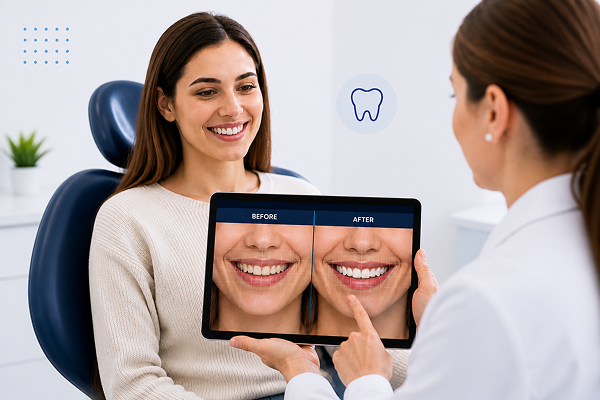
Every dentist knows the moment. A patient sits in the consultation chair, nodding along as you describe veneers, whitening, or a full smile makeover, but the nod is polite, not convincing. Without something concrete to look at, even the best-planned treatment can feel abstract, expensive, and easy to postpone. That gap between “I understand” and “I’m ready to commit” is where practices lose revenue, and it’s exactly what AI-powered smile design software is built to close.
The Problem With Describing a Smile
Cosmetic and restorative dentistry sell an outcome patients can’t yet see. You can explain porcelain shade, tooth proportion, and gum contour in detail, but words only go so far. Industry benchmarks put a healthy practice’s case acceptance rate in the 75–85% range, with many practices quietly sitting 10 to 15 percentage points below that ceiling simply because patients can’t visualize the “after.” For a practice presenting roughly $1 million in treatment annually, closing even a 10-point gap can mean well over $100,000 in recovered revenue in a single year. The tool doesn’t need to work miracles, it just needs to make the outcome real.
What Digital Smile Design (DSD) Actually Is
Digital Smile Design isn’t a new idea; it traces back to work pioneered by Brazilian dentist Christian Coachman in the mid-2000s, which established the now-standard practice of using patient photographs and facial analysis to plan aesthetic treatment before a single procedure begins. What has changed is the technology underneath it. Where early digital smile design required manual image editing and specialized training, AI has made the process almost instantaneous: a patient’s photo goes in, and a realistic, personalized preview comes out in minutes rather than hours.
This is the space DentuluPro‘s Smile Design tool operates in. A patient uploads a photo either in the operatory or remotely via an invite link before their appointment and AI facial analysis generates a realistic simulation of veneers, whitening, implants, orthodontic alignment, or a full mouth reconstruction. Instead of a verbal treatment plan, the patient sees their own face with the proposed result already on it.
Why Seeing Changes Everything
The clinical literature on digital smile design is consistent on one point: patients who visualize a result before committing to it engage differently with the treatment plan. Research on DSD workflows describes patients becoming active participants in their own care rather than passive recipients of a recommendation, which correlates with higher compliance and stronger motivation to follow through. There’s also a documentation benefit that’s easy to overlook: a saved, patient-approved visualization creates a clear record of what was discussed and agreed to, which can reduce misunderstandings and disputes down the line.
For the practice, the effect shows up in three places:
Faster yes decisions. When a patient can compare their current smile to a realistic preview side by side, the mental leap from “maybe someday” to “let’s schedule it” gets much shorter. Uncertainty is usually what stalls a decision, and a clear visual removes most of it.
Higher-value case acceptance. Smile design visualization tends to perform best on exactly the cases where most people want to close veneers, full mouth reconstruction, implants where the investment is significant and the patient’s biggest hesitation is simply not knowing what they’re paying for.
A smoother front-office workflow. Because photos can be collected before the appointment, the visualization is often ready before the patient even sits down for their consultation, turning what used to be a single high-pressure conversation into a more natural discussion around something the patient has already had time to consider.
| Experience Your Smile Makeover Before You Commit Try Smile Design |
Where AI Fits Into an Already-Busy Practice
The honest caveat, backed by the research, is that visualization software is a communication and planning tool, not a guarantee. Outcomes occasionally fall short of a simulation, and no software replaces clinical judgment about what’s actually achievable for a given patient’s anatomy. What AI-based tools like DentuluPro’s do change is the speed and accessibility of that first conversation. Traditional digital smile design workflows could take a trained technician significant time to render a single case. AI-driven tools compress that into minutes, which means visualization stops being reserved for your highest-ticket cosmetic cases and can become a normal part of new patient consultations, hygiene recall visits, or even a pre-appointment step handled entirely online.
That accessibility matters because it changes who gets to have the “aha” moment. It’s no longer just the patient who already suspected they wanted veneers, it’s the patient who came in for a cleaning and mentioned, almost in passing, that they’ve always been self-conscious about their smile. A two-minute visualization, generated on the spot, can turn that offhand comment into a scheduled consultation.
A Practical Starting Point
If you’re evaluating smile design software for your practice, a few questions are worth asking up front: How realistic are the simulations, and do they hold up under a patient’s scrutiny? Can photos be collected remotely before the appointment, or does everything have to happen chairside? Does the pricing model fit your case volume unlimited visualizations for high-volume cosmetic practices, or a pay-as-you-go option for practices just starting to introduce the technology? DentuluPro, for example, offers tiered plans starting around $49 a month along with a credit-based option, which makes it feasible to test the impact on case acceptance before committing to a larger workflow change.
The Bottom Line
Patients don’t reject treatment plans because they doubt your skill; they hesitate because they can’t picture the result and aren’t sure the investment is worth it. AI smile design software addresses that hesitation directly, turning a verbal recommendation into something a patient can see on their own face. For practices looking to close the gap between what they present and what patients accept, it’s one of the more direct returns on a piece of software you’ll find in dentistry today.
| Curious what AI smile design could look like for your practice? Try DentuluPro’s Smile Design tool and see a transformation in minutes. |